



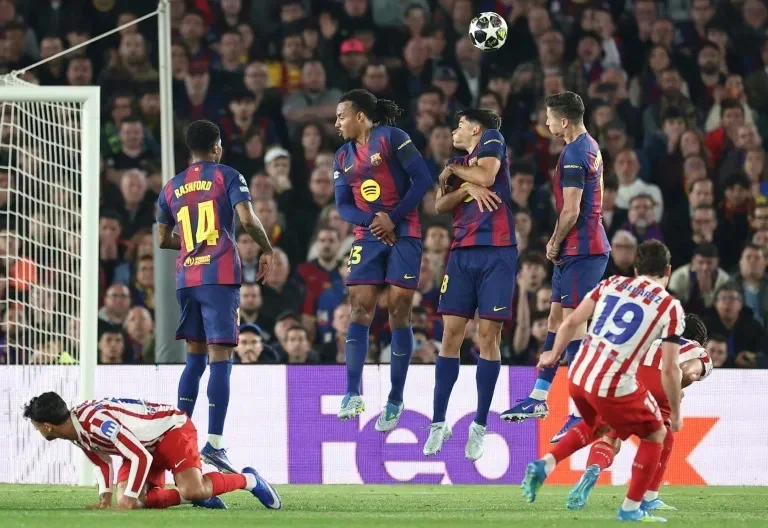
 Barcelona were turfed out of the Champions League at the quarter-final stage by Diego Simeone’s Atletico Madrid (Josep LAGO)” />
As Barcelona’s title celebrations wind down, the empty cava bottles head for recycling and the open-top bus returns to the garage, preparations for the next campaign are already in motion.
Hansi Flick’s back-to-back La Liga titles have brought much-needed stability to the club after a turbulent five-year period that yielded only one domestic league trophy. Yet the bigger prize remains out of reach.
Domestic supremacy alone is insufficient.
Winning the Champions League for the first time since 2015 stands as Barcelona’s primary goal—the true mark that they have returned to the pinnacle of European football following the departure of all-time great Lionel Messi.
This season’s La Liga success, while impressive, represents a slight step back from Flick’s achievements last year, when his side claimed a domestic treble and advanced to the Champions League semi-finals.
With Lamine Yamal and Pedri González shining, Barcelona believed this would be the season they secured their sixth European Cup.
However, the Catalans fell short against domestic rivals Atlético Madrid, losing 3‑2 on aggregate in the quarter‑finals. Flick confirmed last week that winning the Champions League is his top priority.
“There are two things I want in life. First, that we win the Champions League,” said the German coach. “We have a good team for the next years, but we must make the right decisions in the transfer periods — they have to be perfect.”
“The second thing is I want to be coach (at Camp Nou) when it’s fully finished.”
Improving Barcelona’s squad is the first — but not the only — step needed to match teams like Paris Saint‑Germain and Bayern Munich.
As Flick hinted, the club’s financial constraints leave no room for mistakes. Every euro counts, and the margin for error is razor‑thin.
This season, Barcelona’s lack of depth proved costly. They missed high‑calibre players in key positions and pushed the squad to its limit, leading to frequent injury problems.
Barcelona did not replace Íñigo Martínez, who moved to Saudi Arabia. Left‑back Gerard Martin filled in as a converted centre‑back. Although both he and Eric García performed beyond expectations, this remains an area where the club trails Europe’s elite.
Up front, 37‑year‑old Robert Lewandowski and the inconsistent Ferran Torres scored enough goals to help the team win La Liga, but they fell short of Bayern’s Harry Kane or former winger Ousmane Dembélé, now a Ballon d’Or‑winning striker at PSG.
With a left winger and at least one full‑back also on the wish list, the Catalans must rely on their outstanding La Masia academy and trust the emerging talent.
Flick’s predecessor Xavi Hernández brought through Lamine Yamal and Pau Cubarsí, among others, but the German has been more cautious.
That caution was reflected in 18‑year‑old midfielder Dro Fernández’s departure to PSG, while Xavi Espart and Tommy Marques remain on the fringes. Flick was also slow to trust Marc Bernal again after the holding midfielder recovered from injury.
Perhaps Flick is wary of too much inexperience, given that Barcelona’s European exits have often exposed a certain naivety.
They finished both legs against Atlético with ten men after red cards for Cubarsí and Eric García — part of a wider pattern of vulnerability, indiscipline, and, as Barcelona would argue, bad luck.
After last season’s thrilling 7‑6 aggregate semi‑final defeat to Inter Milan, the coach said he would focus on improving Barcelona’s defence. Despite those words, they…
